Service quality is no longer defined solely by how quickly a request is resolved or how polite a response sounds. In today’s experience-driven economy, customers judge businesses by consistency, personalization, responsiveness, and how well their feedback translates into meaningful improvement. Companies that continuously refine their service outperform competitors not because they make fewer mistakes, but because they learn faster.
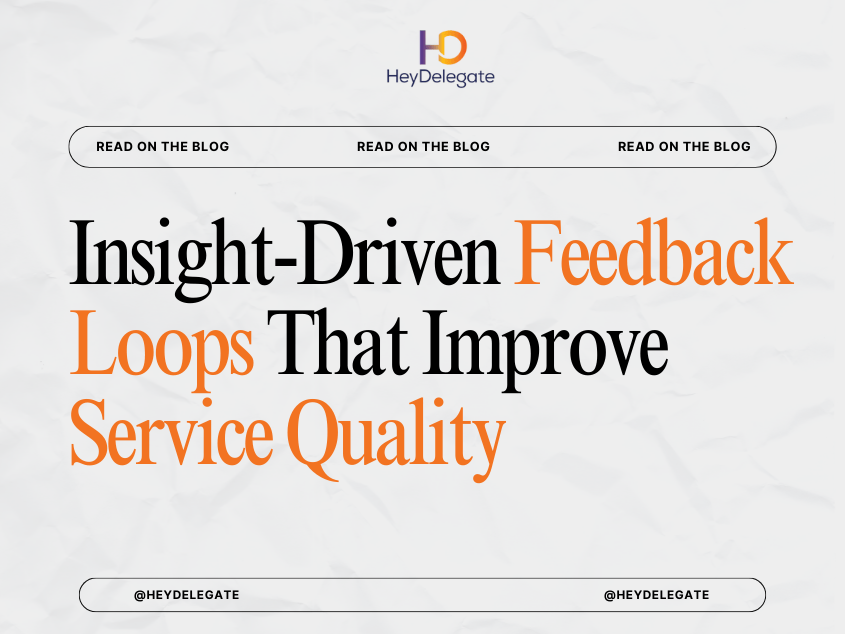
At the heart of this learning advantage are insight-driven feedback loops systems that systematically collect customer input, analyze it intelligently, translate insights into action, and then measure the results. When designed correctly, feedback loops transform raw opinions into operational intelligence that improves service quality at scale.
For businesses that rely on virtual teams, customer support VAs, and remote operations staff, feedback loops are even more critical. Distributed teams cannot rely on hallway conversations or informal observation. Instead, they need structured, repeatable, data-backed systems that provide clarity, accountability, and direction. This in-depth guide explores how to design, implement, and optimize insight-driven feedback loops that elevate service quality, empower virtual teams, and create lasting customer loyalty.
Why Feedback Alone Is Not Enough
Many businesses collect feedback but fail to improve. Surveys are sent, reviews accumulate, and customer comments sit idle in dashboards. The issue is not a lack of feedback, it is a lack of structured insight.
Common Feedback Pitfalls
- Feedback is collected but never analyzed
- Data is reviewed too infrequently
- Insights are not shared with the team
- No ownership exists for acting on feedback
- Improvements are not tracked or measured
- Customers never see evidence of change
Without a closed-loop system, feedback becomes noise instead of guidance.
What Makes Feedback Insight-Driven
An insight-driven feedback loop does more than gather opinions. It:
- Identifies patterns and root causes
- Links feedback to specific processes or behaviors
- Prioritizes improvements by impact
- Assigns responsibility
- Measures outcomes
- Feeds improvements back into operations
This transforms feedback into a continuous improvement engine.
The Anatomy of an Insight-Driven Feedback Loop
An effective feedback loop consists of five interconnected stages:
- Capture – Collect meaningful feedback at the right moments
- Analyze – Convert raw data into actionable insights
- Act – Implement targeted improvements
- Measure – Track performance changes
- Close the Loop – Communicate improvements internally and externally
Each stage must be intentional and repeatable to sustain service quality growth.
Stage 1: Strategic Feedback Capture
The foundation of any feedback loop is collecting the right information from the right people at the right time.
Types of Feedback to Collect
1. Customer Feedback
- Post-interaction surveys
- CSAT (Customer Satisfaction Score)
- NPS (Net Promoter Score)
- Open-ended comments
- Reviews and testimonials
2. Operational Feedback
- Internal QA reviews
- Ticket resolution audits
- Workflow bottleneck reports
3. Team Feedback
- VA feedback on tools and SOPs
- Support agent suggestions
- Cross-functional collaboration insights
Collecting feedback from multiple perspectives provides a 360-degree view of service quality.
Best Practices for Feedback Collection
- Keep surveys short and focused
- Ask one clear objective per survey
- Combine quantitative scores with qualitative questions
- Trigger feedback at meaningful moments (after resolution, onboarding, delivery)
- Use consistent scoring scales
Virtual teams benefit from automated survey triggers that ensure feedback collection is consistent and unbiased.
Stage 2: Turning Feedback into Actionable Insights
Raw feedback has limited value until it is analyzed systematically.
Quantitative Analysis
Metrics like CSAT, NPS, response time, and resolution time provide measurable benchmarks. Trends over time are more important than isolated scores.
Qualitative Analysis
Open-ended responses often reveal deeper insights. Common analysis techniques include:
- Theme tagging
- Sentiment categorization
- Keyword frequency analysis
- Root cause mapping
For example, repeated mentions of “slow response” may indicate staffing gaps, unclear escalation paths, or inefficient tools.
Insight Prioritization
Not all feedback carries equal weight. Prioritize insights based on:
- Frequency
- Severity
- Business impact
- Customer retention risk
- Alignment with strategic goals
Assigning a VA or CX analyst to summarize insights weekly ensures leadership focuses on what matters most.
Stage 3: Translating Insights into Targeted Action
Insights must lead to visible change. This is where many feedback systems fail.
Types of Improvement Actions
1. Process Improvements
- Streamlining workflows
- Clarifying SOPs
- Reducing handoffs
2. Training Enhancements
- Updating onboarding materials
- Coaching on tone, empathy, or clarity
- Skill development sessions
3. Tool Optimization
- Adjusting CRM configurations
- Automating repetitive tasks
- Improving reporting dashboards
4. Policy Adjustments
- Updating refund policies
- Modifying service guarantees
- Revising escalation thresholds
Each action should be documented, assigned, and tracked.
Ownership and Accountability
Every improvement initiative should have:
- A clear owner
- A defined timeline
- Measurable success criteria
Virtual teams perform best when accountability is explicit and progress is visible.
Stage 4: Measuring the Impact of Improvements
Feedback loops only work if improvements are measured objectively.
Key Metrics to Track
- CSAT and NPS trends
- First-contact resolution rate
- Average response and resolution time
- Repeat issue frequency
- Customer retention rates
- Escalation volume
Tracking pre- and post-improvement performance validates whether changes are effective.
Continuous Monitoring
Use dashboards to:
- Compare performance across periods
- Identify regression early
- Highlight improvement success stories
A VA-managed dashboard ensures leadership always has access to real-time performance insights.
Stage 5: Closing the Feedback Loop
Closing the loop is critical for credibility and trust.
Internal Loop Closure
- Share insights with the team
- Celebrate improvements
- Recognize contributors
- Update SOPs and training materials
This reinforces a culture of continuous improvement.
External Loop Closure
- Thank customers for feedback
- Inform them when changes are made
- Acknowledge their contribution
Example:
“Based on your feedback, we’ve improved our response times and updated our support process.”
Customers who see their feedback acted upon are more likely to remain loyal and provide future input.
Building Feedback Loops for Virtual Teams
Virtual teams require intentional feedback systems to replace informal observation.
Best Practices for Remote Teams
- Centralize feedback data in shared tools
- Schedule regular feedback review meetings
- Assign feedback champions
- Use standardized evaluation criteria
- Provide written and video feedback
Clear documentation ensures consistency regardless of location or time zone.
The Role of Virtual Assistants in Feedback Management
Virtual Assistants play a critical role in sustaining feedback loops.
VA Responsibilities May Include:
- Monitoring feedback channels
- Tagging and categorizing responses
- Preparing weekly insight summaries
- Updating dashboards
- Coordinating improvement initiatives
- Maintaining documentation
- Following up on action items
By delegating feedback management to trained VAs, leaders gain clarity without operational overload.
Common Feedback Loop Mistakes to Avoid
Even well-intentioned systems can fail if poorly designed.
Pitfalls Include:
- Collecting too much feedback without focus
- Acting on isolated complaints
- Ignoring internal team feedback
- Failing to communicate improvements
- Measuring activity instead of outcomes
Effective feedback loops are selective, intentional, and outcome-oriented.
Creating a Culture That Values Feedback
Systems alone cannot sustain improvement. Culture matters.
Characteristics of Feedback-Driven Cultures
- Openness to critique
- Psychological safety
- Data-driven decision-making
- Continuous learning
- Shared accountability
Leaders must model responsiveness to feedback and treat it as a strategic asset, not a threat.
Long-Term Benefits of Insight-Driven Feedback Loops
Businesses that master feedback loops experience:
- Higher service consistency
- Improved customer trust
- Faster issue resolution
- Reduced churn
- Better team performance
- Stronger brand reputation
Over time, feedback-driven organizations outperform competitors who rely on intuition alone.
Conclusion: Feedback Is the Engine of Service Excellence
Insight-driven feedback loops are not optional enhancements; they are foundational systems for sustainable service quality. By capturing meaningful input, extracting actionable insights, implementing targeted improvements, measuring results, and closing the loop, businesses create a virtuous cycle of continuous improvement.
For virtual teams, these systems provide clarity, alignment, and direction. For customers, they deliver consistency, responsiveness, and trust. And for leadership, they transform feedback from scattered opinions into strategic intelligence.
When feedback becomes a disciplined, insight-driven process, service quality no longer depends on individual effort it becomes embedded in the organization’s DNA. Get your VA today from HeyDelegate.